Communication Systems
— HimanishIntroduction #
Major Functional Blocks #
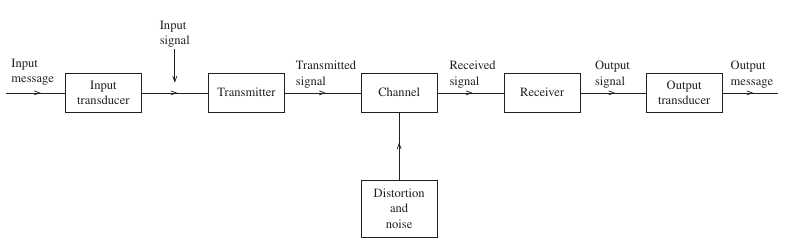
- Transducer: converts nonelectric message to electric signal
Analog to Digital #
- Signal distortion increases with distance
- Digital signals have enhanced immunity to noise and interferences
- A finite alphabet makes the the receiver’s decision more certain
- Analog systems: signals and noise within same BW can’t be separated
- The sampling theorem states that if the highest frequency in the signal spectrum is B (in hertz), the signal can be reconstructed from its discrete samples, taken uniformly at a rate above 2B samples per second
- A quantizer partitions the signal range into L intervals. Each sample amplitude is approximated by the midpoint of the interval in which the sample value falls
Channel Parameters #
Bandwidth and Power #
- Channel bandwidth B and the signal power \(P_s\) control the connection’s rate and quality
- The faster a signal changes, the higher its maximum frequency is, and the larger its bandwidth is
- Increasing \(P_s\)strengthens the signal pulse and suppresses the effect of channel noise and interference, to maintain a minimum SNR (signal-noise-ratio) over a longer distance
Capacity #
\[C = B \log_2(1+\text{SNR})\] It is impossible to transmit at a rate higher than C without incurring a large number of errors.
Amplitude Modulation (AM) #
- Tone modulation: Modulation signal contains single frequency e.g. pure sinusoidal, so impulse arrows instead of continuous spectrum
Baseband versus Carrier #
- Baseband. freq band of original message before modulation, measured close from zero. Much lower freq than modulated signal.
- Carrier has high frequency. Sinusoidal carrier can be formed from AM, FM or PM. (amplitude, freq, phase modulations)
Double-Sideband (DSB) Supressed Carrier AM #
Carrier frequency should be greater than bandwidth of modulating signal
Synchronous/Coherent Demodulation #
Demodulation can be done by repeating the modulation process, and the original message can be obtained via a LPF. But it requires a signal with same frequency as carrier, which is difficult. Signal attenuates/time delay so receiver complexity increases. This is fine for point to point but not broadcast.
Conventional AM (DSB Full Carrier) #
- The carrier is sent with the modulated signal. This can be done by a dc offset \(A_c\) before modulation.
- \(|A_c + m(t)| \geq 0\) to avoid zero crossing to prevent phase reversal in freq domain, which distorts the envelope
- By following the envelope, we can recover the original signal
- \(f_c » f_m\) (max freq of message signal)
Envelope Detection #
- Diode removes negative half
- RC circuit slowly discharges to follow the envelope
- \(2\pi B < \frac{1}{RC} < \omega_c\)
- \(RC \le \frac{1}{\omega_c}\frac{\sqrt{1-\mu^2}}{\mu}\)
Modulation Index #
-
\[\mu = \frac{A_m}{A_c}\]
- \(\mu < 1\) to prevent overmodulation
- \(A_c = \frac{V_{max} + V_{min}}{2}\)
- \(A_m = \frac{V_{max} - V_{min}}{2}\)
\[\mu = \frac{V_{max} - V_{min}}{V_{max} + V_{min}}\]
- \(\mu = \frac{V_{max} - V_{min}}{2V_C + V_{max} + V_{min}}\) for non zero offset
-
For multi-tone modulation \(\mu_T = \sqrt{\mu_1^2+\cdots+\mu_n^2}\)
Power #
- For singletone
\[ P_{SB} = P_c \cdot \frac{\mu^2}{2}\]
- \(P_{tot} = P_c (1 + \frac{\mu^2}{2})\)
- In general, \[P_T = \frac{\overline{m^2(t)}}{2} + \frac{A_c^2}{2}\]
Efficiency #
Useful power resides in sidebands, whereas carrier power is only for convenience in mod-demod. \[\eta = \frac{P_c}{P_{c}+P_{SB}} = \frac{\mu^2}{2+\mu^2}\]
Single Sideband (SSB) #
\[\phi_{\text{USB, LSB}}(t) = m(t)\cos\omega_ct \mp m_h(t) \sin\omega_ct\]
Angle Modulation #
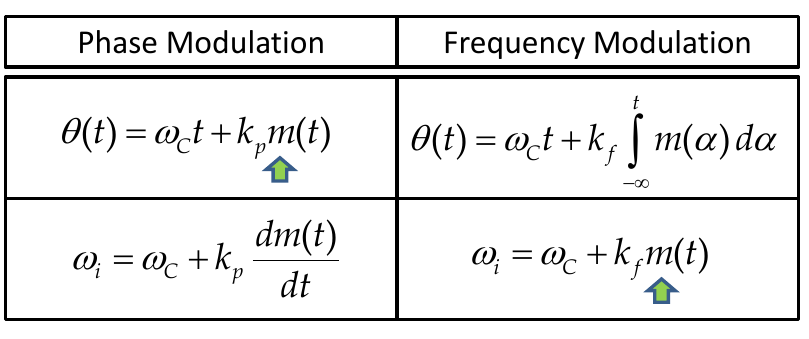
-
Constant amplitude hence \(P_{av} = \frac{A^2}{2}\)
-
Bandwidth required more than AM and depends on modulation index unlike AM
-
Better noise immunity than AM and can be increases with \(\Delta f\)
-
Transmitters and receivers are more complex than AM
-
All transmitted power is useful (no carrier and sidebands)
Single Tone #
- Carrier signal \(A_c\cos\omega_ct\)
- Freq deviation \(\Delta f = k_fA_m\)
- Modulation index \(\beta = \frac{\Delta f}{f_m}\) \[\phi_{FM}(t) = A_c\cos(\omega_ct + \beta \sin\omega_mt)\]
NBFM (Narrowband) #
If \[\left|k_f \int_{-\infty}^t m(\alpha)d\alpha\right| \ll 1\] then \(k_f \int_{-\infty}^t m(\alpha)d\alpha \approx k_f\sin\omega_mt\)
- Bandwidth \(B_{FM} \approx 2f_m\) comparable to AM
- Requires \(\beta \le 0.3\) rad
WBFM (Wideband) #
\[\beta > 0.3\] \(B_{FM}^{WB} \approx 2(\Delta f + B) = 2B(\beta+1)\) [Carson’s rule]
Phase Locked Loop (PLL) #
- Phase detector: output proportional to phase difference between inputs
- VCO (Voltage Controlled Oscillator): monotonic frequency-vs-voltage characteristic (unstable)
- Loop filter: removes hi-freq components
- Stable hi-freq output using a reference lo-freq oscillator
Superheterodyne Receiver #
https://www.youtube.com/watch?v=dk6DdG4vs4Y
Digital Communication #
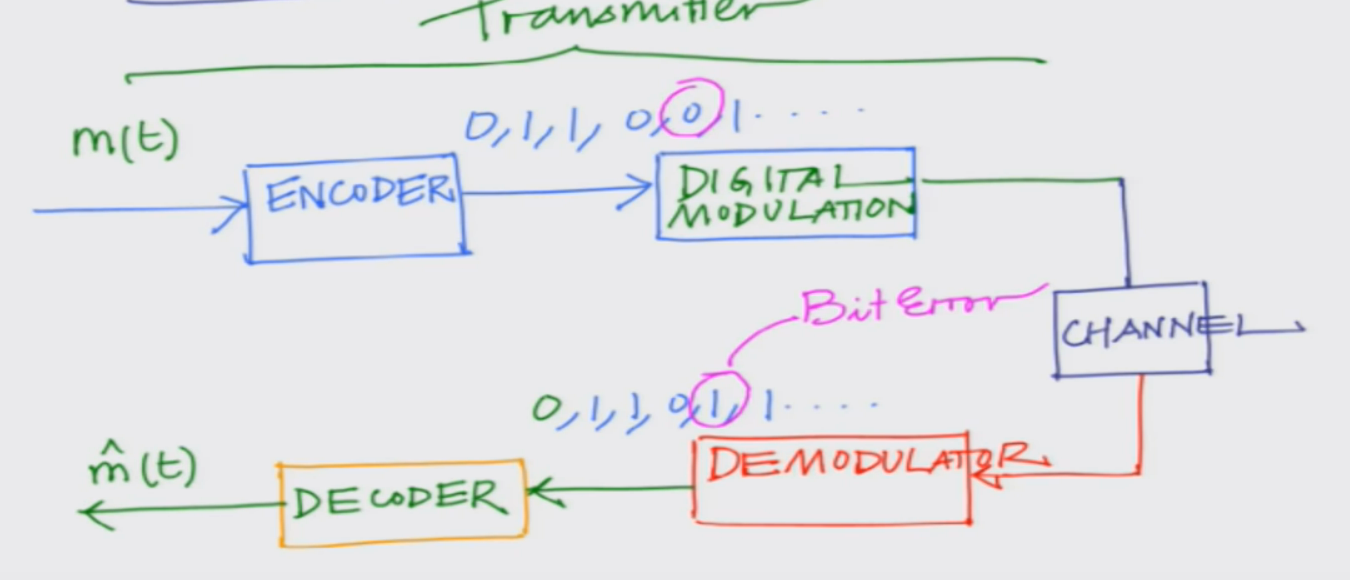 \[x(t) = \sum_k a_kp_T(t-kT) | T: \text{symbol duration}\]
Spectrum of Transmitted Signal #
- Cannot find direct expectation of pulse as that would imply spectrum is zero but we need a spectrum to transmit a signal.
- Hence, power spectral density comes in. For that we need the autocorrelation.
- \(R_{xx}(\tau) = E{x(t)x(t+\tau)} = \frac{P_d}{T}R_{P_TP_T}(\tau)\)
- \(= \sum_kE{a_k^2}p(t-kT)p(t+\tau-kT)\)
- Data Symbol Power \(P_d = E{a_k^2} = A^2\)
- Taking Fourier transform, on both sides, \[\overline{S_{xx}(f)}^{\text{PSD of x(t)}} = \frac{P_d}{T} \overline{S_{PP}(f)}^{\text{Energy Spectral Density}}\]
- \(S_{xx}(f) = \frac{P_d}{T}|P_T(f)|^2 = P_dT sinc^2(fT)\)
AWGN #
- Additive: \(y = x + n\)
- White: Noise samples at any two different times are uncorrelated.
- \(R_{NN}(\tau) = \frac{n}{2}\delta(\tau)\)
- \(S_{NN} = \frac{n}{2}\) i.e. power spread equally across all frequencies just like white light
- Remains Gaussian after any filtering as filter is linear
Data Coding #
Convolutional Code #
- If size of shift register is \(n\), rate of code is \(1/n\), i.e. input sequence is \(1/n\) as long as output
- Either send the code \(n\) times faster so BW required is \(n\) times and energy per coded bit becomes \(1/n\)th so more chance of error in a bit. But we can use parity checks to correct these errors.
- Or send at the same rate but use a higher order modulation e.g. for 3-bit shift register use 8-PSK instead of BPSK so you can send 3 bits at once